Dutch Naval Ship Johan de Witt also headed to the Caribbean

Johan de Witt also goes to the Caribbean

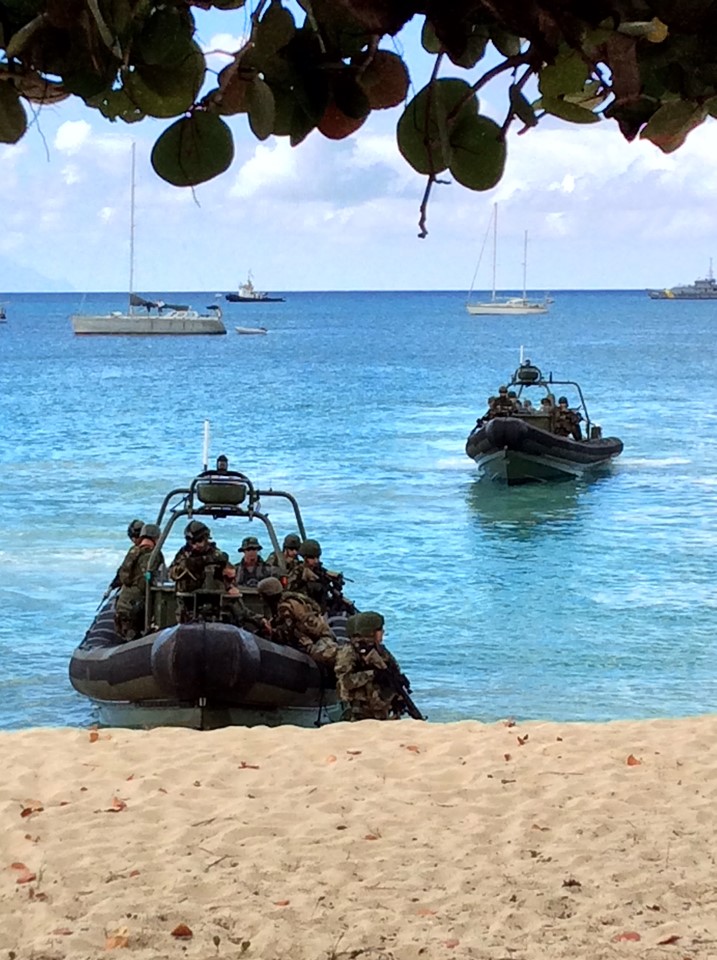
Den Helder – The images of the devastating power of hurricane Irma are still burnt to us all. To remain well trained in providing humanitarian aid, the Defense organization is organizing the Caribbean Coast exercise. The exercise also involves structuring good crisis communication and maintaining public order and safety in the event of a natural disaster. Caribbean Coast takes place this year on Sint Maarten, Saba, Bonaire, St. Eustatius and Curaçao and lasts from 9 to 19 September.

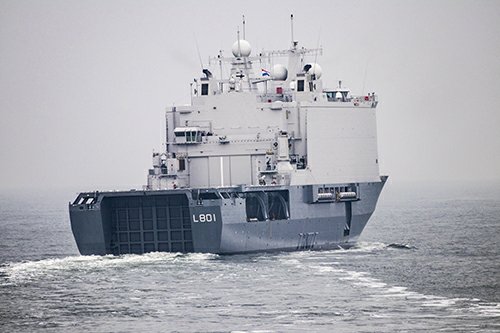
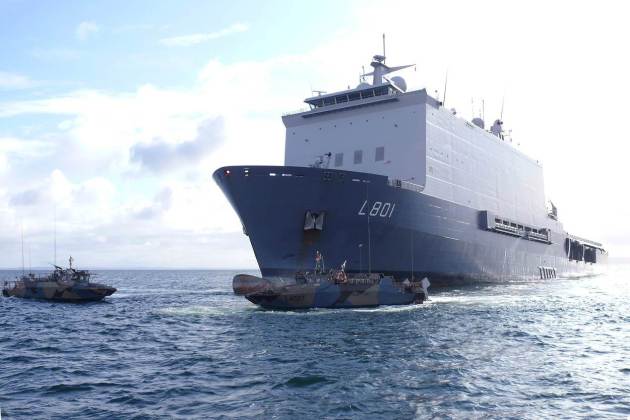
Caribbean Coast is a Dutch exercise, with the participation of the navy, air force and army. Four naval vessels are participating, namely Zr.Ms. Snellius, Groningen, Pelican and Johan de Witt. The amphibious transport ship Zr.Ms. Johan de Witt leaves Den Helder on 26 August for the transatlantic crossing. The other ships are already in the area. The air force participates with three helicopters and the army sends support units of genius, medicine and civil-military cooperation. In total more than 700 Dutch soldiers participate. In addition, French and German soldiers are taking part in this exercise.

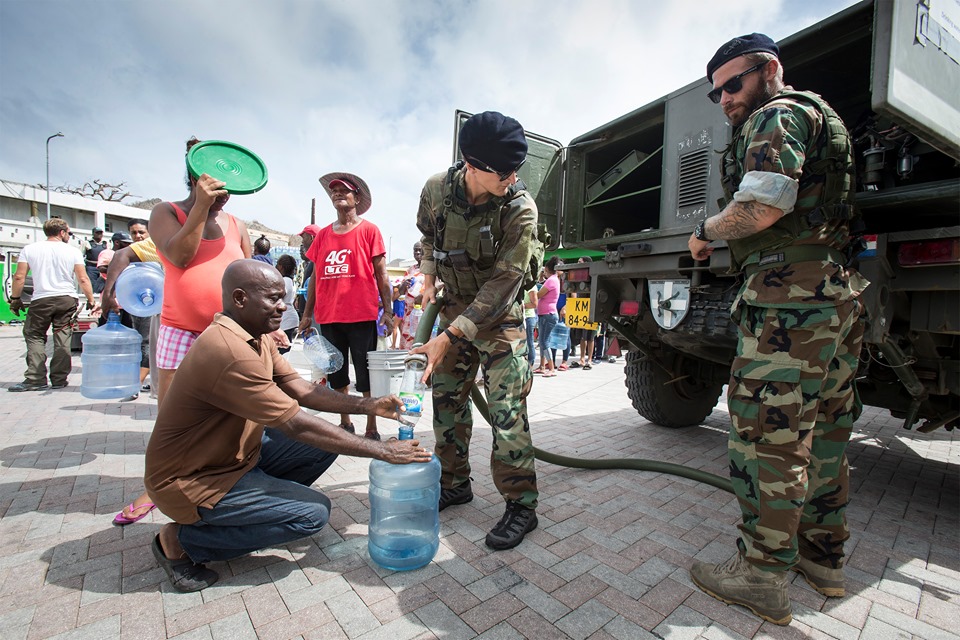
During the Caribbean Coast, soldiers practice evacuating civilians in need, making affected areas accessible, safeguarding public order and security, and providing immediate emergency assistance to victims of natural disasters.

Exercise
Hurricane Irma made it clear that it remains important to be well prepared for hurricane passages and other natural disasters. The Defense organization is practicing this, so that it can properly help the residents of the Kingdom in a disaster situation. Every four years, the Ministry of Defense organizes a large-scale humanitarian exercise in the Caribbean. Defense exercises right there, and in the hurricane season, so that it is as realistic as possible. The soldiers therefore also train on several islands, together with local and civil authorities.

Under ‘Editorial DHA’ you will find messages about DHA itself, supplied (and edited or not) press releases and suchlike.

SOURCE DENHELDER ACTUEEL

Central Bank CEO warns: Moving too fast can be disastrous for the Curaçao economy

Willemstad – The speed that the Netherlands imposes on Curaçao through an order from the Council of Ministers for the reorganization of financial management can be disastrous for the economy of the country.

Bob Traa of the Central Bank for Curaçao and Sint Maarten warned about this during a lunch meeting of the Curaçao Business Association (VBC) on Wednesday. “If we try to adjust fiscal policy too quickly, the economic engine may stall and the debt ratio may even rise.”

Traa advised the government of Curaçao to talk to the Netherlands about a more realistic pace, but then to include a well-founded multi-year plan to convince The Hague. In his performance for the VBC, Traa suggested possible solutions to get the Curacao economy up and running. See below:

ECONOMY OFFER REQUIRES MORE ATTENTION

Willemstad – Today, President Ai of the Central Bank of Curaçao and Sint Maarten (CBCS), Dr. Bob Traa, stimulated those present at a lunch meeting of the Curaçao Business Association (VBC) with his diagnosis of and possible solutions for the current economic situation. situation in Curaçao.

Traa pointed out that labor productivity in Curaçao shows a downward trend. At the same time, the growth of the potential labor force is declining. As a result, the potential growth of the economy is negative. When labor productivity decreases, companies reduce the number of jobs to reduce their costs. This increases unemployment. Curaçao not only has high unemployment, the capital is also not being used optimally. There are many empty buildings and there is talk of liquidity in the banking system. In addition, due to the low productivity, the competitiveness of Curaçao is insufficient and the current account deficit is high. The structure of the economy of Curaçao is gradually shifting from industry to tourism.

Based on this diagnosis, Traa states that the policy on Curaçao should focus on both the demand and the supply side of the economy. Given the large current account deficit, he sees little room to stimulate the economy from the demand side. In addition, in the case of fiscal policy, the pace of implementation of measures should be taken into account. After all, too strong a change in fiscal policy in a short period of time could delay economic activity.

The possibilities for monetary policy actions are also limited, given the fixed link between the guilder and the US dollar. Furthermore, the economic dynamics of Curaçao and Sint Maarten are different. The recession of Sint Maarten is cyclical in nature (V-shaped) while in Curaçao there is a recession of a structural nature (L-shaped).

The emphasis should therefore be on strengthening the supply side of the economy in order to raise potential growth to a higher level. Curaçao should strive to implement a structural reform agenda. These reforms must be aimed at it

making the labor market, the product market and the government apparatus more efficient and productive. The emphasis must be on tripartite deployment and flexicurity , or the protection of people and not specific jobs. The government, the trade unions and the business community must actively cooperate in implementing the reform agenda. With his speech Traa aims to start the dialogue in order to arrive at a jointly supported structural reform agenda.

Click here for the presentation of Traa.

SOURCE: KONINGRIJKSRELATIE

Tyson Issues Fourth Recall of the Year For Having Non-Food Material in Its Chicken. St Maarten on recall list.

Tyson Foods, one of the largest food producers in the world, is having a problem.

Over the course of 2019, the company has issued four separate recalls for its frozen chicken products (one of which was expanded to be much larger). In each case, the problem was “foreign objects,” meaning something ended up in the chicken that’s not supposed to be there.

Let’s start from the beginning! On January 29, the USDA’s Food Safety and Inspection Service (FSIS), the department responsible for food recalls, of more than 36,000 pounds of frozen chicken nuggets. Consumer complaints revealed that some of these nuggets—sold nationwide—were contaminated with bits of rubber.

On March 21, the FSIS for over 69,000 pounds of various flavors of frozen breaded chicken strips. Those chicken strips caused consumer complaints of contamination with bits of metal. They were shipped nationwide, but used for “institutional use” in Michigan and Washington. “Institutional use” means they were part of meals paid for in part by the government; examples would include school and prison meals.

On May 4, the FSIS that frozen breaded chicken strip recall. In addition to the 69,000 pounds in the initial recall, the expanded version included a whopping 11.76 million pounds of these chicken strips. Turns out they were also sent for institutional use nationwide, including to the Department of Defense, and were even exported to Hong Kong, Bermuda, and St. Maarten.

Not done yet! On June 7, the FSISfor frozen “chicken fritters,” to the tune of over 190,000 pounds. The adulteration this time? “Hard plastic.” These fritters caused complaints specifically from schools, which had purchased them for lunches.

And now, most recently, we have of more than 39,000 pounds of frozen breaded chicken patties, sold under the Weaver brand but produced by Tyson. Exactly what was in these patties has not been revealed; the release simply says “extraneous materials.”

Each of these recalls was given a Class 1 status by the FSIS. From the FSIS’s definition of Class 1 recalls: “This is a health hazard situation where there is a reasonable probability that the use of the product will cause serious, adverse health consequences or death.” In each case, the FSIS strongly recommends throwing any of the affected products away, or returning to their place of purchase.

Each of the recalled products were produced in different locations: one in Pine Bluff, Arkansas; one in New Holland, Pennsylvania; one in Rogers, Arkansas; and one in Sedalia, Missouri. This doesn’t seem to be an instance where one factory is responsible for a number of screwups. But all are classified, , as Tyson Poultry facilities. This is a significant uptick in Tyson “foreign material” recalls; in 2018, there . The newest recall makes four this year, and it’s only August.

We’ve reached out to Tyson to find out why foreign objects keep ending up in frozen chicken products, but have yet to hear back.

SOURCE: MODERN FARMER

Venezuelan Invasion Imminent? Dutch Naval Vessel Zr.Ms. Van Speijk Joins NATO Squadron to The American East Coast.

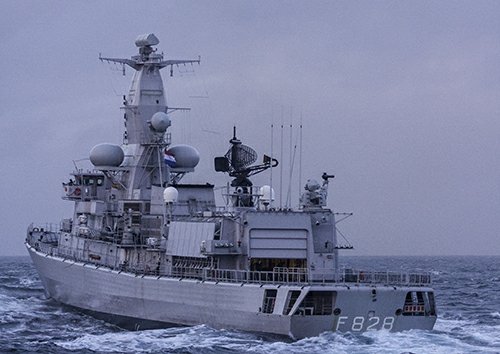
While an (EU) mission in the Strait of Hormuz is being discussed in The Hague and soon in Helsinki, the ‘reserved’ M-frigate Zr.Ms. Van Speijk just left Den Helder on Saturday for a tour with the NATO squadron SNMG1, which will mainly practice on the Atlantic Ocean. This was confirmed by a spokesperson for the navy this afternoon opposite. The Johan de Witt will also make the crossing on Monday. Previously Zr.Ms. Snellius and Zr.Ms. De Ruyter already on the Atlantic Ocean. 
This morning, De Telegraaf reported that the Netherlands is only willing to send a naval ship in an EU context. Whether an EU mission is actually coming and how it will take shape is not yet known. Among other things, this will be discussed next week in Helsinki, Finland, during a meeting of Defense Ministers. 
Subsequently, the House of Representatives will also consider the plans and it is expected that it will not be known until September whether the Netherlands will make a contribution. Zr.Ms. Van Speijk did not wait. The ship that has been designated by the navy to be deployed in the Strait of Hormuz in case of green light already had other obligations and will not wait in the Helderse marine port for the agreement from The Hague. 

A spokesperson for the navy said this afternoon that the Van Speijk will be leaving on Saturday and will join SNMG1. There will be a real reunion, because apart from Norwegian and American ships, there are two relocated relatives: the M frigates NRP Francisco de Almeida and BNS Leopold I. These ships sailed under the Dutch flag as Hr.Ms. Van Galen and Hr.Ms. Karel Doorman.
With the NATO squadron, the Van Speijk will practice along the American east coast and then return to the European side of the ocean for the large NATO exercise Dynamic Mariner, where Zr.Ms. Johan de Witt will participate. 

Whether the Van Speijk will actually complete the entire three-month program with SNMG1 is uncertain. The chance is serious that the ship will set course for the Strait of Hormuz in September. 
Johan de Witt
The New Haven will be empty after the leave, because on Monday the amphibious transport ship Zr.Ms. Johan de Witt also leave. The ship will make the crossing and head to the West. There it will participate in the first of the two amphibious exercises that are on the JWIT program this fall. 

During the exercise in the West, called Caribbean Coast, the Landing Platform Dock (LPD) with the existing Dutch naval vessels Zr.Ms. Pelican, hydrographic survey vessel Zr.Ms. Snelius (who left last week) and Groningen to provide emergency humanitarian aid. On board the ship is the staff, the Maritime Battle Staff, led by commander Ad van de Sande and of course the so-called embarked forces. The latter group, however, does not consist of Dutch Marines, but of German units of the Seebataillon (which works closely with the Netherlands on an amphibious level) and French Marines of Martinique. As you know, it has been very restless in neighboring Venezuela for some time, but that would not have been the reason for the exercise. Even hurricane Irma, who ran a huge household two years ago on the Caribbean island of Sint Maarten, was not the direct reason for this exercise. Because these disaster relief exercises have been held every four years for a long time. However, according to a spokesman for the navy, the natural disaster has shown that practicing on such situations is very important.
The exercise consists of two phases, the first phase takes place on the windward islands and the second on the windward islands. Caribbean Coast starts on September 9 and ends ten days later. 

It is not the first time that Johan de Witt has been in the Caribbean; in 2011 there was a station ship (in time for the OPVs who could take on tasks) and the much larger Caribbean Archer exercise took place. Like the even larger Joint Caribbean Lion in 2006 (with the Rotterdam), this exercise focused on amphibious operations high in the spectrum of violence. High in the spectrum of violence.
If the Caribbean Coast is an exercise low in the spectrum of violence, the major NATO exercise that is on the agenda in October is actually (amphibious) warfare again. The Johan de Witt will have to return to the north for that. From the Spanish Rota (where the US Navy is also located), ships leave for the ‘Article 5’ exercise Dynamic Mariner that starts on October 7 and ends on the 18th.

In the fall of 2018, Johan de Witt was also active in the amphibious field during the largest NATO exercise in times of Trident Juncture. All these exercises are of extra importance for the Netherlands because in 2020 our country will lead the amphibious task force of the NATO Response Force. So if NATO deployed the rapid reaction force in that year in the event of a conflict or disaster, the Netherlands would lead the international amphibious task force. 

LCF Zr.Ms. De Ruyter left earlier this week and is on his way to the American east coast for exercises with an American Carrier Task Group.


SOURCE: MARINE SCHEPEN

The Ministry of Defense is providing emergency aid in the Caribbean from 9th to 19th September 2019

Kralendijk – Caribbean Coast is a Dutch exercise, with the participation of the navy, air force and army. Four naval vessels are participating, namely Zr.Ms. Snellius, Groningen, Pelican and Johan de Witt. The amphibious transport ship Zr.Ms. Johan de Witt leaves Den Helder on 26 August for the transatlantic crossing. The other ships are already in the area. The air force participates with  three helicopters and the army sends support units of genius, medicine and civil-military cooperation. In total more than 700 Dutch soldiers participate. In addition, French and German soldiers are taking part in this exercise.

Caribbean Coast takes place this year on Sint Maarten, Saba, Bonaire, St. Eustatius and Curaçao and lasts from 9 to 19 September. During the Caribbean Coast, soldiers practice evacuating civilians in need, making affected areas accessible, safeguarding public order and security, and providing immediate emergency assistance to victims of natural disasters. In addition, the structuring of good crisis communication is also discussed.

Hurricane Irma made it clear that it remains important to be well prepared for hurricane passages and other natural disasters. The Defense organization is practicing this, so that it can properly help the residents of the Kingdom in a disaster situation. Structurally, the Defense organization is organizing a large-scale humanitarian exercise in the Caribbean. Defense exercises right there, and in the hurricane season, so that it is as realistic as possible. The soldiers therefore also train on several islands, together with local and civil authorities.

Source and photos: Defense Caribbean

BONAIRENU

Design a site like this with WordPress.com
Get started